
St. Louis HVAC Lifespan: How Long Do HVAC Systems Last?
If your furnace just made it through another January cold snap or your air conditioner struggled to keep up during a July heat wave, you’re probably wondering how much life your HVAC system actually has left. St. Louis weather doesn’t do mild. Our summers push into the mid-90s with brutal humidity off the rivers, and our winters swing hard the other direction, and that constant back-and-forth wears equipment down faster than manufacturers’ national averages suggest. At Ashley Brothers Heating & Cooling, we get asked almost daily about St. Louis HVAC lifespan, whether it’s time to repair or replace, and the honest answer depends on more than just age.
Average HVAC Equipment Lifespan in St. Louis
How Long Does HVAC Equipment Last in St. Louis?
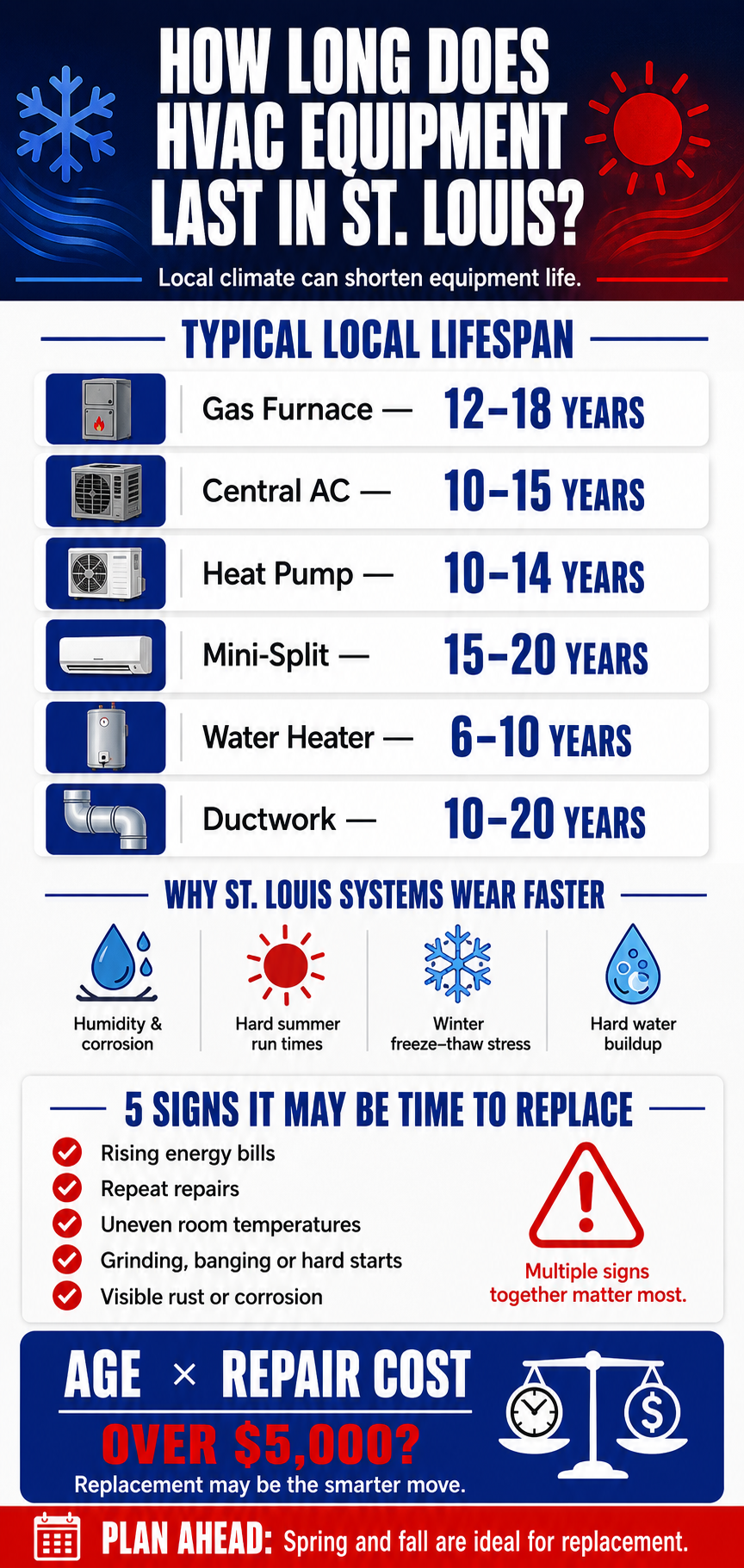
HVAC equipment in St. Louis typically lasts several years less than the national average because of our humid continental climate and its dramatic seasonal swings. A furnace that might run 18-20 years in a milder climate often needs replacing closer to 12-15 years here, and central air conditioners frequently show real wear by year 10 rather than year 15. We’ve found that the region’s combination of high summer humidity, hard freezes, and older housing stock is the biggest factor separating St. Louis lifespans from the numbers printed on a manufacturer’s brochure.
Why Does St. Louis Weather Shorten HVAC Lifespan?
St. Louis weather shortens HVAC lifespan because equipment here rarely gets a break. According to the National Weather Service’s St. Louis climatology summary, the region sits at the meeting point of the Mississippi and Missouri Rivers and regularly pulls in warm, humid air from the Gulf each summer, with temperatures of 90 degrees or higher on roughly 35 to 40 days a year. That kind of sustained heat and humidity forces air conditioners to run long, hard cycles for months at a time, while winter cold snaps keep furnaces working overtime. That constant demand, with almost no shoulder season for equipment to rest, adds up to more wear per calendar year than a system installed in a milder region ever sees.
Humidity is the quieter culprit. Moisture in the air accelerates corrosion on coils, electrical connections, and heat exchangers. We routinely see condensers in St. Louis backyards showing rust and coil degradation years before a similar unit would in a drier climate. Add in the hard water common across St. Louis County and the city, and it’s easy to see why local lifespans run shorter. Missouri American Water’s St. Louis region water quality report lists total hardness in the 4 to 13 grains per gallon range, mineral levels that build scale inside water heaters and can affect humidifiers tied into HVAC systems over time.
What Are the Warning Signs an HVAC System Needs Replacement?
The clearest warning signs that an HVAC system needs replacement are rising energy bills, frequent repairs, uneven temperatures between rooms, and a system that’s simply aging out. Any one of these on its own might just mean a repair, but two or three together usually point toward replacement being the smarter long-term move.
Watch for these specific signs in your St. Louis home:
- Energy bills climbing year over year even though usage habits haven’t changed
- Repair calls happening more than once a season, especially during peak summer or winter stretches
- Rooms that never quite match the thermostat setting, particularly upstairs bedrooms in older two-story homes
- Strange noises like grinding, banging, or a compressor that struggles to start
- Visible rust or corrosion on the outdoor condenser or indoor coil
- A system over 12 years old that’s using R-22 refrigerant, which is being phased out and getting expensive to source
- Humidity control that feels off, with a home that’s clammy in summer despite the AC running
If you’re seeing several of these at once, waiting it out usually means paying for one more repair before an even bigger failure hits during the worst possible week of summer or winter.
When Should You Call a Professional Instead of Waiting?
You should call a professional as soon as you notice a system struggling to keep up, making unusual noises, or requiring repeat repairs within the same season. Some maintenance is fine to handle yourself. ENERGY STAR’s maintenance checklist recommends inspecting or changing air filters monthly and keeping the area around outdoor units clear, both easy habits during peak season here, especially once overgrown grass and yard debris pile up in St. Louis backyards by midsummer.
Anything involving refrigerant, electrical components, gas connections, or a system that’s short-cycling needs a trained technician. St. Louis’s humidity and temperature extremes mean small issues escalate faster here than in milder climates, so a strange smell or sound is worth a call sooner rather than later.
Not sure if your system needs a look? Schedule An Inspection with our team today.
What Are the Most Common Causes of Early HVAC Failure in St. Louis?
The most common causes of early HVAC failure in St. Louis are oversized cooling loads from humidity, deferred maintenance, aging ductwork in older homes, and hard water damage to water heaters and humidifiers. Ranked by how often we see them in the field:
- Humidity overload on the AC system. Units working overtime to dehumidify as well as cool wear out compressors faster.
- Skipped maintenance. A missed spring tune-up before a brutal summer often turns a $200 fix into a $2,000 failure.
- Aging ductwork. Many homes across St. Louis City and the surrounding county were built decades before modern duct sealing standards, leading to air loss and uneven strain on the system.
- Hard water buildup. Sediment in water heaters and steam humidifiers shortens their working life significantly.
- Freeze-thaw stress on outdoor units. Winter ice buildup followed by rapid spring thawing can crack components over time.
How Can You Prevent Early HVAC Breakdown?
You can prevent early HVAC breakdown with seasonal maintenance timed to St. Louis’s climate, specifically a spring AC tune-up before the humidity hits and a fall furnace check before the first hard freeze. Change filters every one to three months, more often if you have pets or live near high-traffic roads where dust and pollen build up quickly.
Keep outdoor condensers clear of leaves, grass clippings, and the cottonwood fluff that blankets yards across the region every spring. Indoors, make sure vents aren’t blocked by furniture, and consider a whole-home dehumidifier if your basement or lower level stays damp, which is common in older St. Louis homes with less-than-ideal grading. These small habits genuinely extend equipment life by several years when done consistently.
Seasonal HVAC Maintenance Checklist for St. Louis Homes
A season-by-season maintenance schedule keeps St. Louis systems running longer by matching upkeep to the specific stress each season puts on the equipment. Use this as a quick reference for what to check and when.
| Season | Key Task | Why It Matters Locally |
|---|---|---|
| Spring | Professional AC tune-up and coil inspection | Gets the system ready before Gulf humidity and 90-degree days set in |
| Summer | Check filters monthly, clear condenser of debris | Long, humid cooling season means the AC rarely gets a break |
| Fall | Furnace inspection, heat exchanger check | Catches issues before the first hard freeze hits the region |
| Winter | Monitor for ice buildup on outdoor units, check carbon monoxide detectors | Freeze-thaw cycles and heavy furnace use raise the stakes |
What Results Can You Expect From Timely Replacement?
Timely replacement of aging HVAC equipment typically delivers 15-30% lower energy bills, more even temperatures throughout the home, and fewer emergency repair calls during peak season. Modern energy-efficient HVAC systems in St. Louis are built to handle humidity more efficiently than units from a decade or two ago, which matters enormously in a climate like ours.
Homeowners who replace before a full breakdown also avoid the worst-case scenario: a dead AC during a 95-degree St. Louis heat wave or a failed furnace during a January cold snap, both of which come with rushed decisions and premium emergency pricing.
Common Mistakes Homeowners Make With Aging HVAC Systems
One common mistake is repairing an aging system indefinitely instead of comparing the cumulative repair cost to a replacement. If repairs in a single year approach a third of replacement cost, that money is usually better spent moving forward. Another mistake is ignoring proper sizing during replacement. An oversized system cools too fast without managing our region’s humidity, leaving homes feeling clammy despite a comfortable temperature reading. Skipping ductwork inspection during a system swap is a third common misstep, since a brand new furnace or AC connected to leaky, decades-old ducts across St. Louis’s older housing stock will underperform no matter how efficient the unit itself is.
A Common Local Scenario
We frequently see this pattern in South City and older St. Louis County neighborhoods: a homeowner has a 16-year-old furnace and matching AC system, both original to the house. The furnace still runs but the AC has needed two repairs in the past two summers, and the electric bill has crept up noticeably. After an inspection, we typically find the coil corroded from years of humidity exposure and the ductwork undersized for the home’s square footage. Replacing both systems together, sized correctly for the home, usually resolves the comfort complaints and brings the energy bill back down within the first full season.
How Do Repair and Replacement Compare for Older Systems?
Repairing makes sense when the system is under 10 years old and the repair cost is modest, while replacing makes more sense once a system passes 12-15 years or repair costs start stacking up. A helpful rule we use with St. Louis homeowners: multiply the age of the unit by the repair cost. If that number exceeds 5,000, replacement is usually the better financial move.
Weighing repair versus replacement? Get A Free Estimate before deciding.
What Does It Cost to Ignore an Aging HVAC System?
Ignoring an aging HVAC system in St. Louis typically leads to higher energy bills, a greater risk of mid-season breakdown, and the possibility of secondary damage like water leaks from a failing condensate line or reduced air quality from a struggling system. The longer replacement is delayed past the 12-15 year mark, the more likely a failure happens during peak heat or cold, which also tends to mean longer wait times for emergency service across the region.
Don’t wait for a breakdown. Book Your Replacement Consultation now and get ahead of the season.
Frequently Asked Questions
How long do furnaces last in St. Louis?
Furnaces in St. Louis typically last 12-18 years, somewhat shorter than the national average due to the demanding winter cycling our climate requires.
How long do air conditioners last in St. Louis?
Air conditioners in the St. Louis area generally last 10-15 years, with humidity-driven compressor wear being the main factor shortening lifespan compared to drier climates.
Is it cheaper to repair or replace an HVAC system?
Repair is typically cheaper for systems under 10 years old with isolated issues, while replacement becomes more cost-effective once a system passes the 12-15 year mark or repair costs climb toward half the price of a new unit.
What time of year is best to replace HVAC equipment in St. Louis?
Spring and fall are ideal, since scheduling ahead of the summer humidity or winter cold avoids emergency pricing and long wait times during peak-demand months.
Does humidity really affect HVAC lifespan?
Yes. St. Louis’s humid summers accelerate corrosion on coils and electrical components, which is a major reason local lifespans run shorter than national averages.
Can I extend my HVAC system’s life with maintenance alone?
Regular seasonal maintenance can add several years to a system’s working life, but it can’t fully offset the natural wear caused by age and our region’s demanding climate.
Should I replace my furnace and AC at the same time?
If both units are close in age, replacing them together often makes sense, since matched systems perform more efficiently and you avoid paying for labor twice in a short span.
Ready to Plan Ahead?
Whether your system is showing early warning signs or you’re just trying to plan for the years ahead, Ashley Brothers Heating & Cooling is happy to walk through what makes sense for your home and your budget. St. Louis weather doesn’t give HVAC equipment an easy ride, and knowing where your system stands now means fewer surprises later.